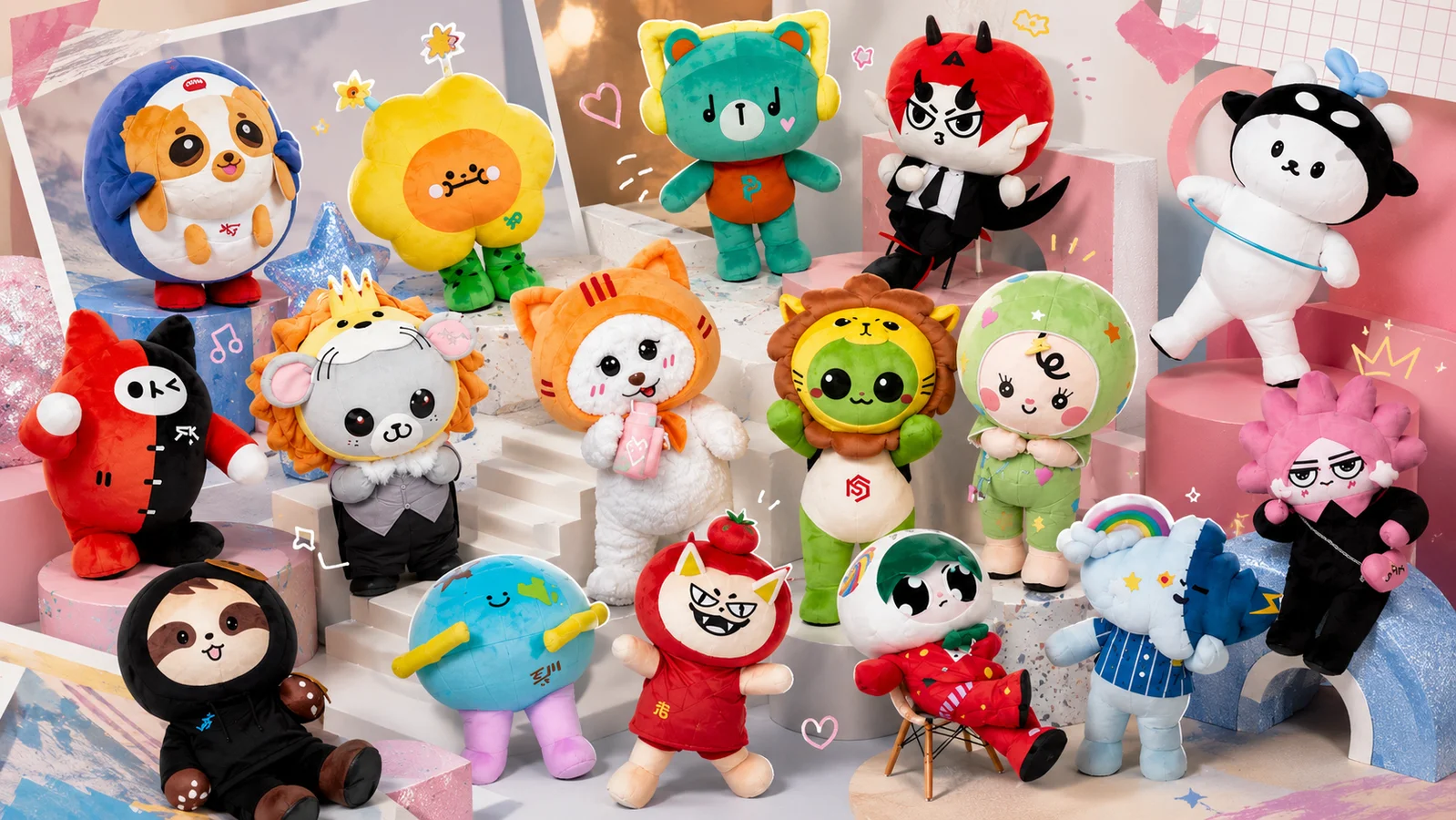
If you follow Thai BL artists online, you may have noticed that the actors are no longer the only personalities appearing at fan meetings, concerts and promotional events.
Standing beside them might be a polar bear-orca hybrid, a mouse wearing a lion costume or another colorful creature with its own name, personality and social media presence. Fans carry smaller versions of these characters to events, pose them beside food and even refer to them as the “children” of their favorite pairing.
Welcome to the world of Thai BL mascots.
What exactly is a BL mascot?
A Thai BL mascot is an original character associated with an artist pairing, fandom or entertainment company. Its design usually combines details connected to both performers: favorite animals, personality traits, colors, inside jokes or symbols already recognized by their fans.
The character can serve several purposes at once. It may represent the fandom, embody the identity of the pairing or become a fictional member of the little family created around the artists and their supporters.
Not every mascot follows exactly the same concept. Some are officially introduced as representations of the fans. Others are treated more like companions or the pairing’s child. Fans also frequently expand the official backstory through affectionate nicknames, jokes and traditions of their own.
And despite the playful language used around them, these mascots do not imply that the actors are a real-life couple. They belong to the public-facing identity built around an established artist pairing.
GMMTV’s “My Ideal Fan” characters
GMMTV helped make the current mascot wave especially visible through its My Ideal Fan project. Participating artists helped design characters intended to represent their supporters, often combining their individual preferences into one recognizable creation.
Among the best-known examples is Look Khunnoo, the mascot associated with Gemini Norawit and Fourth Nattawat. The character combines a mouse with a lion-inspired costume, drawing from animals selected by the two performers. GMMTV officially introduced Look Khunnoo in March 2024 as the pair’s “My Ideal Fan” character.
There is also Polcasan, associated with Tay Tawan and New Thitipoom. Its design combines a polar bear and an orca while its name connects it directly to Polca, the TayNew fandom. Polcasan has become one of the most recognizable examples of a mascot developing an identity beyond its original illustration.
Other characters represent pairings, individual performers and even music groups. This means the phenomenon is not exclusive to BL, although BL and GL fandoms have helped make it particularly visible internationally.
They are more than plush toys
The easiest way to encounter a mascot is through merchandise. Characters can appear as plush dolls, keychains, bags, apparel, stationery and collectible figures. Fans often bring the dolls on trips or to concerts, creating the impression that the mascot is attending alongside them.
But some characters have moved beyond merchandise.
Life-size versions make appearances at concerts, fan meetings, store openings and entertainment events. They interact with performers, pose for photos and sometimes develop recognizable behaviors. A mascot may also receive a birthday, backstory, dedicated social account or its own promotional campaign.
At that point, it stops functioning as only a logo. It becomes an entertainment personality.
Why are they called the pairing’s “children”?
Thai BL fandom has long used family language to describe the relationship between performers, supporters and the community surrounding a pairing. Mascots give that language a physical form.
When one character combines something from each artist, it can be jokingly presented as their shared creation—or their “child.” The actors may participate by referring to themselves with parental titles, taking the mascot to events or playing along with its fictional personality.
For fans, this adds another layer of storytelling without requiring a new series. The mascot can continue appearing even when the actors are working on separate projects or between major releases.
However, “child” is not a universal or mandatory label. Official materials may instead describe the character as a representative of the fandom. The family interpretation often develops through the interaction between the artists, companies and fans.
Why have mascots become so popular?
Mascots fit naturally into Thailand’s growing character and collectible culture. Cute original characters already appear throughout Thai advertising, tourism, cafés and entertainment, with personalities such as Butterbear demonstrating that a mascot can become an influencer-like celebrity in its own right.
For entertainment companies, a mascot also creates an identity that can live across multiple formats. It can appear in animation, videos, social posts, live events and merchandise without being tied to one television role.
For fans, the attraction is more emotional. A small plush is easier to carry and photograph than a poster, and it allows fans to include their favorite pairing in everyday life. Traveling mascot photos have consequently become their own style of fandom content.
The characters also provide a visual language that works internationally. A fan may not understand every Thai-language interview, but a mischievous mascot interrupting its “parents” onstage needs very little translation.
A fandom symbol with a life of its own
Thai BL mascots sit somewhere between a fandom logo, an original character and a tiny celebrity.
They begin as combinations of colors, animals and shared references, but the most successful ones gradually develop personalities through official content and fan participation. Their popularity shows how Thai entertainment companies have expanded artist pairings beyond series, music and fan meetings into character-driven worlds that audiences can collect and help shape.
So the next time a brightly colored creature appears beside your favorite Thai BL actors, it probably is not a random plush toy. It has a name, a story and—if the fandom has anything to say about it—a very busy schedule.