Stories about queer people and religion often arrive at the same painful crossroads: keep your faith or embrace who you are. One identity must be sacrificed so the other can survive.
Ticket to Heaven refuses that choice.
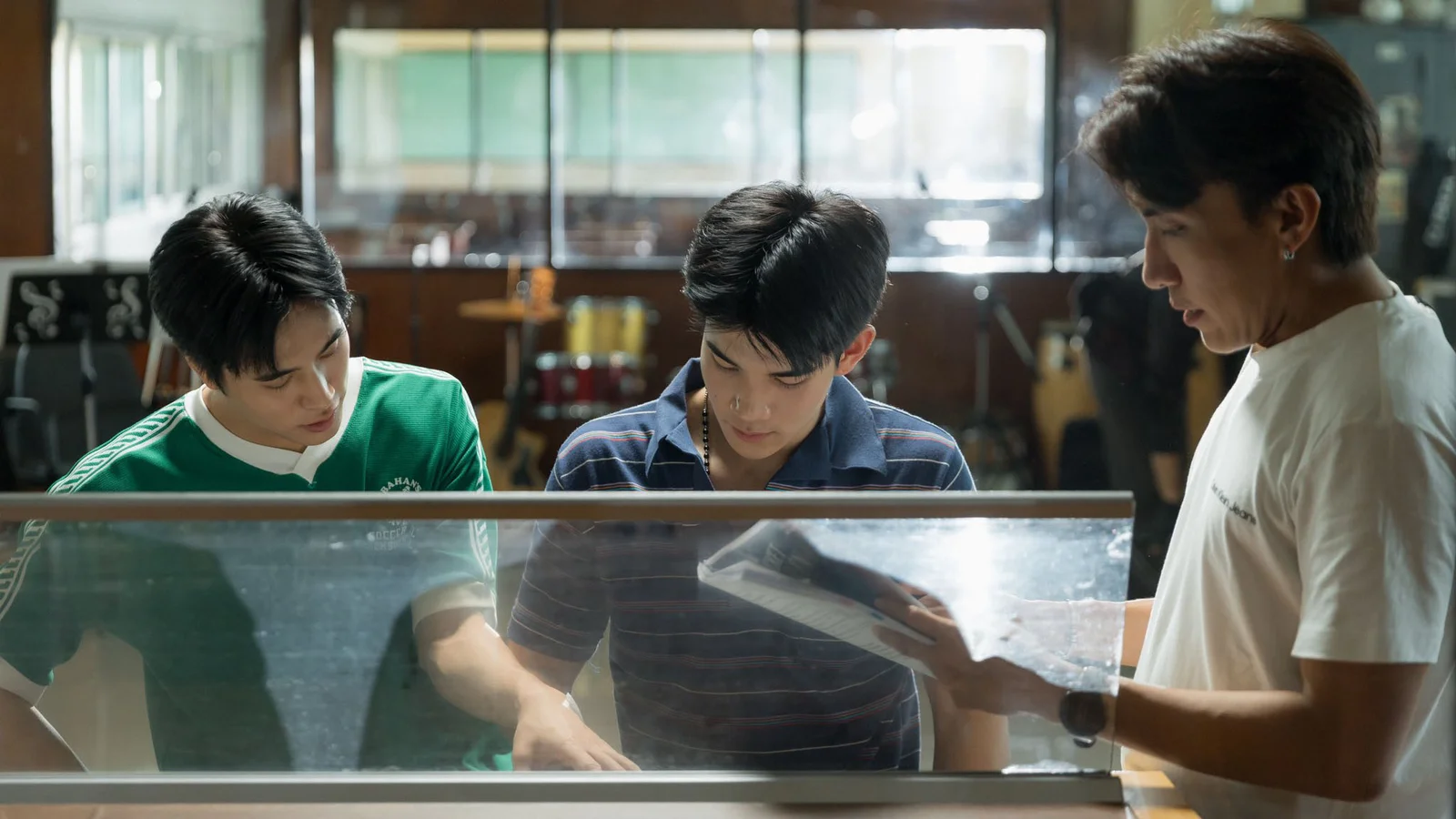
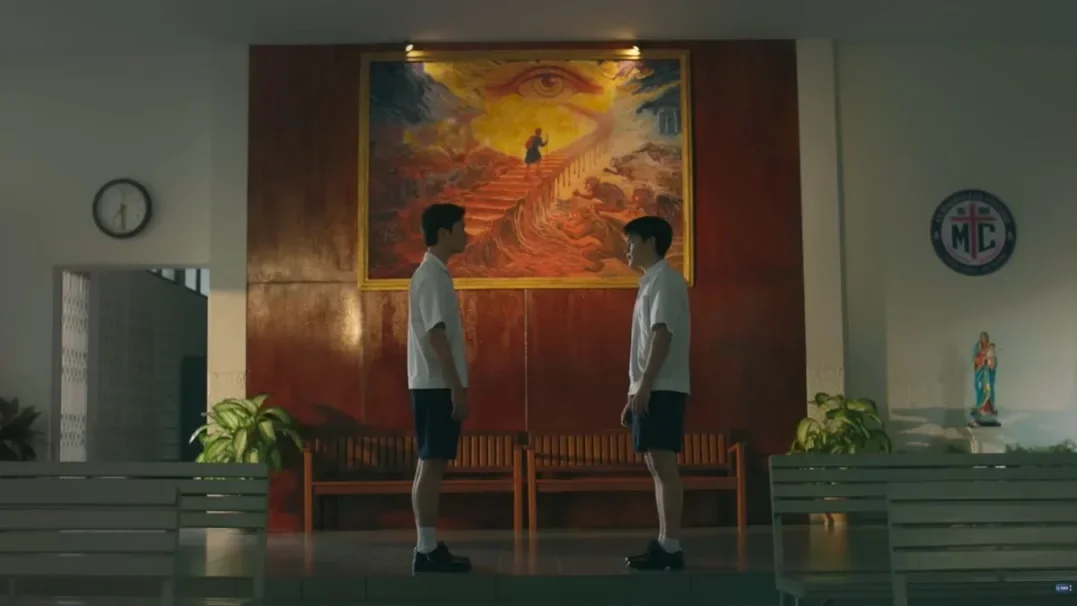
Set primarily in 1996, the Thai BL drama follows Tanrak, a devout student who dreams of becoming a priest, and Barth, a rebellious classmate whose arrival unsettles everything Tanrak believes about himself. Their growing intimacy forces Tanrak to confront a question he has never been permitted to ask: Can his love for another boy exist alongside his love for God?
The series’ answer is not that Tanrak must reject religion. Nor does it ask him to suppress his sexuality in exchange for salvation. Instead, Ticket to Heaven argues that the conflict was manufactured by people—and that neither God nor love demanded the choice in the first place.
A story shaped by memory, not autobiography

Writer-director Aof Noppharnach Chaiyahwimhon, better known as P’Aof, has described the series as being inspired by his personal experiences and memories, while clarifying that it is not a direct retelling of his life.
In a Teen Vogue interview, P’Aof explained that the 1996 setting reflects both his own timeline and an era when conversations about LGBTQ+ identity were far less visible. The period is not simply nostalgic window dressing. It creates the silence surrounding Tanrak: a world in which he possesses neither the vocabulary nor the social permission to understand what he feels.
P’Aof sees parts of himself in both protagonists. Barth voices questions and frustrations that Tanrak is afraid to acknowledge, while Tanrak embodies the fear of losing the faith and future that have given his life structure. Their relationship therefore becomes more than a romance between opposites. It is a conversation between different parts of the same queer experience.
That personal perspective is what gives the drama its emotional specificity. Ticket to Heaven understands that religious conflict is not always a battle between a queer person and an obviously cruel institution. Sometimes it happens internally, when teachings about shame become indistinguishable from one’s own thoughts.
Religion is not the villain
The series could easily have presented the church as a straightforward antagonist. Instead, P’Aof deliberately avoids making faith itself the enemy.
That decision does not erase the harm caused by religious judgment. Tanrak’s fear is real, as are the social pressures surrounding him. But Ticket to Heaven separates those pressures from the possibility of faith itself. The problem is not that Tanrak believes in God. It is that he has been taught to believe God’s love has conditions.
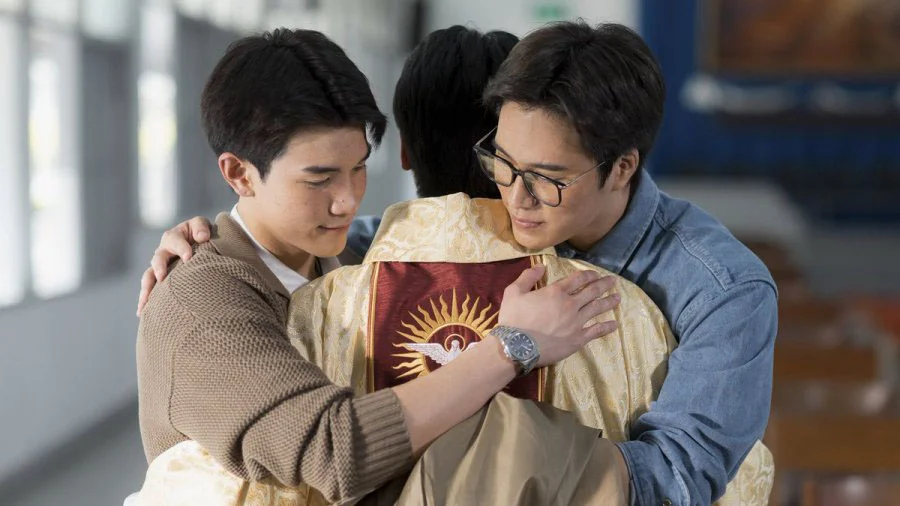
Father Arnon becomes essential to dismantling that idea. Rather than representing a church determined to punish Tanrak, he offers the compassion Tanrak has been denied. His presence allows the series to deliver its most radical reassurance from within the faith: Tanrak does not need to become someone else to remain worthy of divine love.
P’Aof and the writing team treated the religious setting with considerable care. According to the Teen Vogue interview, they consulted a priest throughout development, checking details ranging from biblical language to the prayers that would have been used during the period. That research supports the show’s refusal to treat religion as a convenient villain or an exotic aesthetic. It engages seriously with faith because faith is serious to Tanrak.
Na Lek embodies the answer
If Father Arnon articulates the show’s message, Na Lek lives it.
As a transgender woman who remains connected to her faith, she disrupts the assumption that queer identity and religion are naturally incompatible. She is not waiting for permission to reconcile the two. She has already built a life in which both belong.
Na Lek’s importance becomes especially clear in the finale. She offers Tanrak an alternative to the false choice consuming him: a person can love God without learning to hate themselves.
Her inclusion also expands the drama beyond the central romance. Barth and Tanrak are not presented as the first queer people ever to face these questions. They are part of a larger, often hidden community whose members have found different ways to survive, believe, love, and create families.
Viewers repeatedly singled out Na Lek as the person Tanrak most needed to meet. Her appearance turns the show’s hopeful philosophy into something tangible. Rather than merely telling Tanrak that another kind of life is possible, Ticket to Heaven allows him to see someone already living it.
Choosing hope is not the same as ignoring pain
A tragic ending might have seemed more “realistic” for a queer romance set in 1996. Ticket to Heaven, however, rejects the idea that suffering is automatically more truthful than happiness.
P’Aof told Teen Vogue that his own experience influenced this decision. As a gay man with a happy life and relationship, he wanted to affirm that being LGBTQ+ “doesn’t have to end as a tragedy.”
That choice resonated strongly with audiences. Community reactions were overwhelmingly affectionate, with viewers describing the drama as beautiful, emotionally lingering, and even restorative. Several rated it among their favorite series of the year, while others said it exceeded their initial expectations about how GMMTV would handle such a sensitive subject.
Gemini and Fourth’s performances received particular praise. Fourth’s portrayal of Tanrak was frequently highlighted for communicating intense emotion through silence, while the pair’s chemistry, the cinematography, and the soundtrack helped the six-episode story feel larger than its brief runtime.
The response was not universally celebratory, however. Some viewers felt the series was almost too gentle with its subject. For those familiar with religious trauma, the conflict’s relatively easy resolution risked feeling like a softened version of a far more complicated reality. If the pressure surrounding Tanrak is resolved too neatly, the happy ending can appear less earned than intended.
Even enthusiastic viewers identified the abbreviated structure as a weakness. A common wish was for an additional episode between the fifth and sixth installments—one that would show more of Tanrak’s internal struggle, his decision to leave with Barth, and the practical danger of their escape. Moving directly to Barth’s house denied the audience a potentially crucial stage in Tanrak’s transformation.
These reservations do not necessarily contradict the series’ hopeful purpose. Instead, they reveal the difficulty of what Ticket to Heaven attempts. A story can reject queer tragedy without minimizing queer pain, but finding the balance between those goals requires time. With only six episodes, some emotional and narrative transitions inevitably feel compressed.
Hope as a creative choice
The happy ending does not undo what Barth and Tanrak endure. It gives that pain a different meaning. Their suffering is not evidence that their love is doomed or sinful. It is evidence of the forces they must learn to see clearly before they can imagine another future.
That distinction matters in a genre sometimes criticized for turning queer pain into either spectacle or proof of artistic seriousness. Ticket to Heaven treats hope as an intentional creative choice. Its optimism may not satisfy viewers who wanted a harsher examination of religious trauma, but it is not naïve by accident. It is reparative by design.
The show’s refusal to punish its characters also explains why it affected so many viewers so deeply. For audiences accustomed to preparing for the worst, realizing that the story would not deliver the expected tragedy became part of its emotional power.
A different kind of salvation
The “ticket to heaven” Tanrak seeks at the beginning of the series represents certainty. He believes that if he follows the prescribed path closely enough, he will eventually be reunited with everything he has lost.
Barth complicates that belief because loving him makes Tanrak feel both alive and afraid. Their relationship cannot offer certainty, but it can offer something Tanrak’s rigid idea of salvation cannot: a life that belongs to him.
By the end, heaven is no longer merely a distant reward earned through obedience. It can also be found in being known completely and loved without qualification.
That is why Ticket to Heaven does not conclude by asking whether Tanrak chooses God or Barth. The question itself has become inadequate. The series imagines faith not as a locked gate that queer people must beg to enter, but as something spacious enough to hold truth, doubt, desire, and love.
For Barth and Tanrak, the happy ending is more than romantic wish fulfillment. It is the freedom to stop treating their own happiness as a sin.
What did you think of Ticket to Heaven? Rate the series—and Gemini and Fourth’s performances—on BLA.